
A collaborative divorce attorney is a Florida lawyer who represents one spouse in a collaborative law process, an out-of-court method in which both spouses and their attorneys sign a participation agreement to settle without a judge.
Choosing that attorney means checking credentials, training, fee terms, safety screening, and a plan for what happens if talks end.
Regina F. Zelonker, P.A., a family law and mediation firm in Palmetto Bay and Coral Gables, Florida, provides collaborative divorce representation to Miami-Dade spouses.
The choice of lawyer shapes the whole divorce. Regina F. Zelonker, P.A. answers process and fee questions in a confidential consultation before anything is signed.
A collaborative divorce attorney advises and negotiates for one spouse inside a process the spouses have agreed in writing to resolve without a court ruling. Section 61.56, Florida Statutes, describes this lawyer as the attorney representing a party in the collaborative process.
The process can address issues including the divorce itself, dividing property, parenting time, child and spousal support, relocation, paternity, and marital agreements.
Each spouse has a separate attorney, and the team can add neutral professionals. Of the Florida cases professionals voluntarily reported for a 2025 FACP analysis, 92% included a neutral financial professional and 84% included a neutral facilitator.
Under Section 61.57, Florida Statutes, the process begins once the participation agreement is signed, and either spouse can withdraw at any time, with or without a reason; any Miami-Dade family law client can discuss this with an attorney before signing.
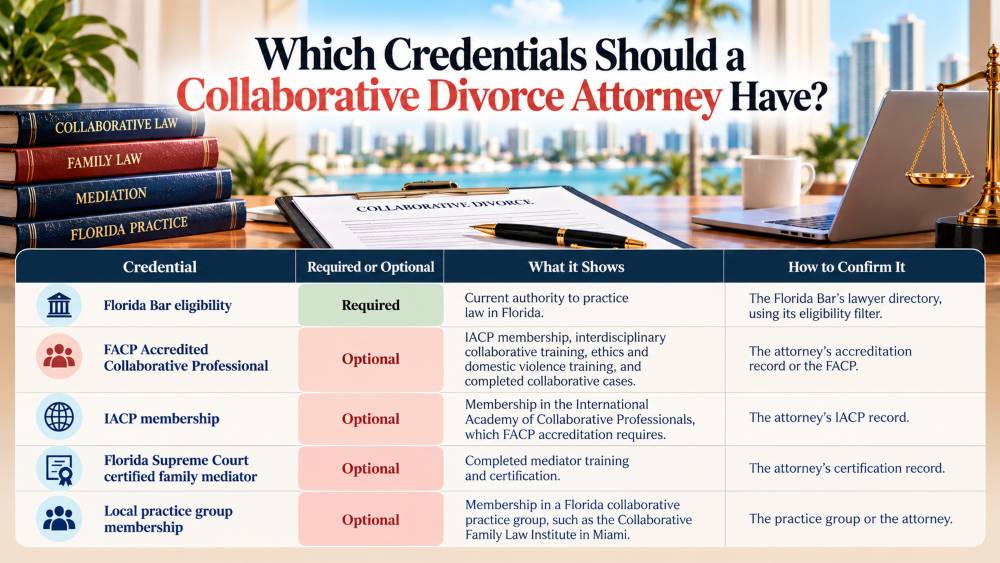
Florida Bar eligibility is the one credential the law requires; the others are voluntary and show training beyond a law license. The table separates the two and shows how to confirm each.
| Credential | Required or optional | What it shows | How to confirm it |
| Florida Bar eligibility | Required | Current authority to practice law in Florida | The Florida Bar’s lawyer directory, using its eligibility filter |
| FACP Accredited Collaborative Professional | Optional | IACP membership, interdisciplinary collaborative training, ethics and domestic violence training, and completed collaborative cases | The attorney’s accreditation record or the FACP |
| IACP membership | Optional | Membership in the International Academy of Collaborative Professionals, which FACP accreditation requires | The attorney’s IACP record |
| Florida Supreme Court certified family mediator | Optional | Completed mediator training and certification | The attorney’s certification record |
| Local practice group membership | Optional | Membership in a Florida collaborative practice group, such as the Collaborative Family Law Institute in Miami | The practice group or the attorney |
The FACP describes its training hours, case documentation, peer references, and three-year Florida Bar standing requirement in its attorney accreditation application.
Accreditation documents training and completed cases; it does not predict the outcome of any particular divorce. Zelonker’s professional background lists her own collaborative and mediation credentials.
Spouses get the most from a consultation by asking about training, team structure, disclosure, and fees, and by checking each answer against something verifiable. Each question below is paired with what a complete answer contains.
Couples who would rather share one neutral than retain two attorneys can also compare family mediation.
Before a client signs, a Florida collaborative attorney must give the client enough information to make an informed choice, under Rule 4-1.19 of the Rules Regulating The Florida Bar.
A Florida Bar Journal review of the 2017 collaborative rules notes that the Florida Supreme Court added fees and costs to the required discussion.
The same rule requires a written participation agreement, signed by every lawyer and client, in which each spouse promises to share relevant information promptly and fully, without formal discovery, and to update anything that changes.
Couples who already signed marital agreements can include those documents in that exchange.
Spouses can confirm the attorney has covered each of these subjects:
Each required explanation is a fair question to raise. Regina F. Zelonker, P.A. welcomes prospective clients who ask these questions at an initial meeting.
The process can end in several ways under Section 61.57, and once it ends, both collaborative attorneys generally step aside, and each spouse hires new counsel for court. Florida Family Law Rule of Procedure 12.745(f) applies that bar to the collaborative lawyers and to lawyers in their firms.
The process ends when a spouse gives written notice that it is over, files or asks a court to act in a related case without everyone’s consent, or loses an attorney through discharge or withdrawal.
A departing attorney does not end the process if, within 30 days of the required notice, the spouse retains a new collaborative attorney and the parties reaffirm the agreement in writing.
Asking a court to approve an agreement, with all parties’ consent, does not end the process.
Rule 12.745(f) leaves two limited openings for the collaborative lawyer: seeking court approval of an agreement reached in the process, and seeking or defending an emergency protective order until a successor lawyer is available.
Confidentiality and privilege are different protections under Section 61.58, Florida Statutes.
Confidentiality extends only as far as the spouses agree in a signed document or as the law provides; privilege keeps collaborative communications out of discovery and evidence, subject to waiver by all parties and the listed exceptions.
Records obtained outside the process, such as bank statements, do not become protected just because they were shared in it. Spouses who want to keep the same lawyers if talks fail can compare cooperative divorce, which has no disqualification clause.
A Florida collaborative attorney must ask, before taking the case and throughout it, whether the client has a history of violence or coercion involving the other spouse. Rule 4-1.19 controls what follows.
When the attorney reasonably concludes such a history exists, the collaborative representation cannot start or continue unless the client asks for the process and the attorney reasonably concludes the client can be kept safe.
That decision turns on each client’s circumstances, so spouses with safety concerns can ask how the attorney screens and which other routes, including mediation with safeguards or court proceedings, remain open. Official court and self-help links appear on the firm’s Miami-Dade court resources page.
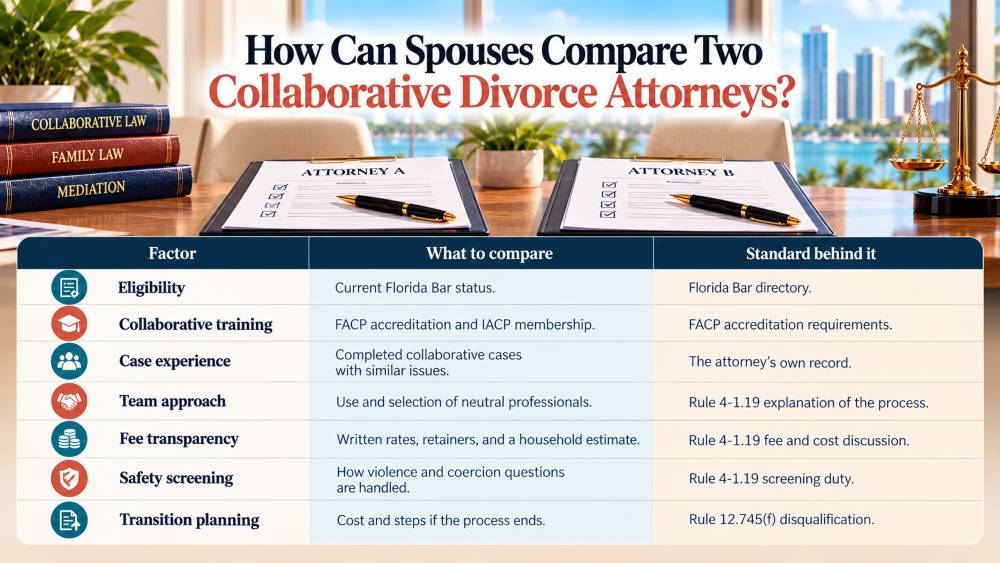
Spouses can compare two attorneys factor by factor, using each factor’s standard to judge the answers.
| Factor | What to compare | Standard behind it |
| Eligibility | Current Florida Bar status | Florida Bar directory |
| Collaborative training | FACP accreditation and IACP membership | FACP accreditation requirements |
| Case experience | Completed collaborative cases with similar issues | The attorney’s own record |
| Team approach | Use and selection of neutral professionals | Rule 4-1.19 explanation of the process |
| Fee transparency | Written rates, retainers, and a household estimate | Rule 4-1.19 fee and cost discussion |
| Safety screening | How violence and coercion questions are handled | Rule 4-1.19 screening duty |
| Transition planning | Cost and steps if the process ends | Rule 12.745(f) disqualification |
Mediation, cooperative divorce, and litigation remain available when collaboration does not fit. Mediation uses one neutral mediator, cooperative divorce keeps both attorneys if talks fail, and court proceedings decide the issues when spouses cannot agree.
How can someone check whether a Florida attorney is eligible to practice?
The Florida Bar’s online directory lets anyone search members by name, firm, city, county, or practice area and limit results to lawyers currently eligible to practice. Spouses can check a collaborative divorce attorney’s status there before booking a first consultation.
What is the difference between confidentiality and privilege in a collaborative divorce?
Confidentiality under Section 61.58 covers only what the spouses agree to keep private in a signed document or what the law protects. Privilege keeps collaborative communications out of discovery and evidence, with exceptions, while records obtainable elsewhere, such as bank statements, stay discoverable.
How long does a collaborative divorce take in Florida?
In the 2025 FACP analysis of voluntarily reported Florida cases, close to 30% finished within three months, 60% within six months, and over 90% within one year. Timing in any single case depends on its issues and the spouses’ cooperation.
Can a collaborative divorce continue if one attorney withdraws?
Yes, under Section 61.57, the process continues if, within 30 days of the withdrawal notice, the spouse hires a new collaborative attorney, the parties reaffirm the participation agreement in writing, and the new attorney confirms the representation in a signed document.
Can a collaborative attorney represent a spouse in court later?
Generally no, Florida Family Law Rule of Procedure 12.745(f) keeps collaborative lawyers and their firms out of the related court case. Limited exceptions cover asking a court to approve a collaborative agreement and emergency protective orders until a successor lawyer is available.
What fee information must a collaborative attorney provide?
Rule 4-1.19 of the Rules Regulating The Florida Bar requires the attorney to discuss expected fees and costs before the client agrees to the process. That discussion includes the lawyers and any mental health or financial professionals on the collaborative team.
What happens if there is a history of domestic violence?
Rule 4-1.19 requires a collaborative attorney to ask about violence or coercion involving the other spouse. When such a history exists, the case can proceed only if the client asks for the process and the attorney reasonably concludes the client can stay safe.
Does each spouse need a separate collaborative attorney?
Yes, Florida’s Collaborative Law Process Act contemplates that each party in the process has a collaborative attorney. Both spouses and both attorneys sign the participation agreement, and any neutral facilitator or financial professional works with both spouses rather than one side.
Spouses can confirm Florida Bar eligibility first, then weigh optional credentials such as FACP accreditation alongside case experience with similar issues. Each attorney’s answers on fees, team structure, and disclosure can be judged against written estimates and the explanations Rule 4-1.19 requires. Planning should also cover the possibility that the process ends, including new counsel under Rule 12.745(f) and the limits of confidentiality and privilege. It must be noted that every case is different. Generalizations, such as in this article, are just that: generalizations, and are subject to variations depending on each specific case.
Asking the right questions protects both the process and the family. Regina F. Zelonker, P.A. helps Miami-Dade spouses start the conversation about collaborative divorce.