

Collaborative divorce vs. litigation cost depends on how much work each process requires, how complex the finances are, and whether the case settles.
In 120 of 217 Florida collaborative cases reported to the Florida Academy of Collaborative Professionals (FACP), combined fees for both spouses totaled $50,000 or less.
Regina F. Zelonker, P.A., a family law and mediation firm in Palmetto Bay and Coral Gables, Florida, estimates contested Miami-Dade litigation in excess of $30,000 in attorneys fees’ per spouse and helps spouses compare collaborative representation and court budgets on the same basis.
Every family’s budget looks different. Regina F. Zelonker, P.A. reviews process, fit, likely professional fees, and risks during a confidential consultation before either spouse commits.
In 120 of 217 fee-reported cases, Florida collaborative divorce totaled $50,000 or less for all professionals and both spouses, about 55%. The FACP Research Committee drew those cases from 299 completed matters that Florida collaborative professionals voluntarily reported since 2014, and published the results in The Florida Bar Family Law Section’s Commentator in 2025.
Collaborative divorce works as an out-of-court process in which each spouse retains a separate collaborative attorney, and both sign a participation agreement under the Collaborative Law Process Act, Sections 61.55–61.58, Florida Statutes.
The team often adds a neutral facilitator and a neutral financial professional who work with both spouses.
| Total professional fees (both spouses combined) | Share of 217 reported cases (rounded) | Number of cases |
| $20,000 or less | 11% | 24 |
| $20,001–$30,000 | 13% | 29 |
| $30,001–$40,000 | 18% | 38 |
| $40,001–$50,000 | 13% | 29 |
| $50,001–$75,000 | 19% | 42 |
| $75,001–$100,000 | 10% | 22 |
| More than $100,000 | 15% | 33 |
The FACP figures reflect voluntarily reported Florida cases, not every collaborative divorce in the state, so the table works best as a range of outcomes rather than a price quote for any individual Miami-Dade family law matter.
Regina F. Zelonker, P.A. estimates that contested Miami-Dade divorce litigation costs in excess of $30,000 in attorneys’ fees per spouse and runs 12 to 36 months, although actual costs and timelines vary widely with the number of disputed issues, and additional experts retained.
Several cost drivers can push a litigated case toward or past the top of that range.
Florida judges can shift part of that spend. Section 61.16, Florida Statutes, allows a court to order one spouse to contribute a reasonable amount toward the other’s attorneys’ fees after weighing what each spouse can afford and overall financial circumstances.
Couples who settle through family mediation before trial avoid trial delays and most late-stage trial preparation, even when some early preparation has already been billed.
Filing fees and parenting-course rules stay the same in both processes, while expert, information-exchange, and hearing costs can differ. Both tracks begin with the $409 dissolution fee on the Miami-Dade Clerk of the Court fee schedule.
| Cost category | Collaborative divorce | Contested litigation |
| Miami-Dade filing fee | $409 dissolution fee | $409 dissolution fee |
| Parenting course (minor children) | Required unless excused for good cause | Required unless excused for good cause |
| Financial expert | Often one neutral financial professional for both spouses | One shared expert, separate experts, or none, depending on disputes |
| Mental health professional | Often one neutral facilitator for both spouses | Evaluators or experts only when parenting issues are contested |
| Information exchange | Voluntary full disclosure at team meetings | Formal discovery, subpoenas, and depositions |
| Court time | Usually limited to approval of the final agreement | Motions, hearings, and possible trial |
| Mediation | Not required; settlement happens in team meetings | Court-ordered sessions at $60 or $120 per person in circuit programs, or a private mediator’s rates |
Parents in either track must complete the Parent Education and Family Stabilization Course, a course of at least 4 hours required by Section 61.21, Florida Statutes, before the court enters final judgment.
Neutral professionals appeared in most reported Florida collaborative cases: 92% used a neutral financial professional and 84% used a neutral facilitator.
Fee estimates mean little without matching assumptions. Regina F. Zelonker, P.A. helps spouses compare both budgets before choosing a process.
A failed collaborative case could possibly add costs because Florida Family Law Rule of Procedure 12.745(f) bars both collaborative attorneys and lawyers in their firms from representing the spouses in related court proceedings.
Each spouse then hires new litigation counsel and pays a new retainer, although the next attorney can still use the financial records already gathered.
Rule 12.745(f) carries two narrow exceptions. A collaborative lawyer may still ask the court to approve an agreement reached during the process and may seek or defend an emergency protective order when no successor lawyer is immediately available.
Under Section 61.57, Florida Statutes, either spouse may end the collaborative process for any reason, and filing a court pleading without the other spouse’s consent ends the process automatically. The FACP analysis found that more than 85% of reported Florida collaborative cases reached full agreement, while about 11% ended without one.
Spouses who want court as a fallback without changing lawyers often compare cooperative divorce, a negotiated process with no disqualification clause, before either spouse signs a participation agreement.
Collaborative divorce tends to offer a cost advantage when both spouses commit to full disclosure, the issues would otherwise require competing experts, and the couple can negotiate safely in the same room. The advantage becomes uncertain when trust or safety is in doubt.
A single neutral financial professional can value a closely held business or retirement portfolio for both spouses, which may replace two competing valuations in court. Spouses who signed premarital agreements prior to the marriage often have fewer asset questions left to resolve.
About 80% of the Florida collaborative cases in the FACP analysis involved minor children. A neutral facilitator can keep parenting-plan talks in one room, which may reduce the need for separate custody evaluations, although the benefit varies with how far apart the parents start.
High conflict, suspected hidden assets, and a history of coercion reduce or erase the expected savings. Rule 4-1.19 of the Rules Regulating The Florida Bar requires a collaborative lawyer to screen each client for a violent or coercive relationship with the other party, and Zelonker’s mediation background supports referral to a better-suited process when screening raises concerns.
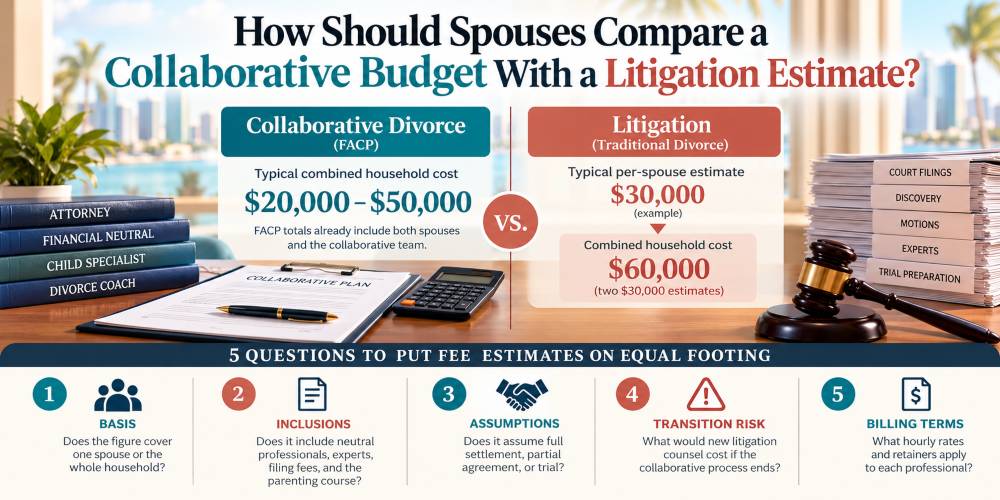
Spouses compare the two processes fairly by converting both quotes to the same basis: combined household cost, the same list of included expenses, and the same settlement assumptions.
FACP totals already combine both spouses, while a per-spouse litigation estimate must be added to the other spouse’s estimate, which may differ, before comparison.
As a hypothetical, two $30,000 per-spouse litigation estimates add up to a $60,000 household figure, which can then be set beside the combined FACP brackets on equal terms.
Five questions put competing fee estimates on equal footing:
Cost control in either process depends on cooperation and billing terms, so spouses who gather bank, retirement, mortgage, and tax records early and keep attorney correspondence inside scheduled meetings can reduce billable hours when both sides follow through.
How much does a collaborative divorce cost in Florida?
In the 2025 FACP analysis, collaborative divorce in Florida cost $50,000 or less for all professionals and both spouses in 120 of 217 fee-reported cases. About 15% of reported cases exceeded $100,000, often because of complex assets or high conflict.
Is collaborative divorce cheaper than going to court in Miami-Dade?
Collaborative divorce can cost less than contested Miami-Dade litigation when shared neutral professionals replace competing experts and the case settles. Final costs in both processes depend on the level of conflict, asset complexity, and whether spouses reach an agreement, so neither process offers a guaranteed price advantage.
What is the filing fee for a divorce in Miami-Dade County?
The Miami-Dade Clerk of the Court charges a $409 filing fee for a dissolution of marriage petition. The same $409 fee applies whether spouses finalize a collaborative settlement, a mediated agreement, or a contested case decided by an Eleventh Judicial Circuit judge.
Do both spouses need separate attorneys in a collaborative divorce?
Yes, each spouse retains a separate collaborative attorney under the Florida Collaborative Law Process Act, Sections 61.55–61.58, Florida Statutes. Both attorneys and both spouses sign a participation agreement, and neutral professionals such as a facilitator or financial professional serve both spouses jointly.
What happens to legal fees if a collaborative divorce falls apart?
Florida Family Law Rule of Procedure 12.745(f) generally bars both collaborative attorneys from representing the spouses in related court proceedings. Each spouse then hires new litigation counsel and pays a new retainer, with narrow exceptions for approving agreements and emergency protective orders. This requirement ensures that the collaborative attorneys are focused only on settlement, and not future litigation.
Can a Florida judge order one spouse to pay the other’s attorney’s fees?
Yes, in litigated cases, Section 61.16, Florida Statutes, allows a court to order one spouse to pay a reasonable amount toward the other spouse’s attorney’s fees and costs. Judges decide after comparing each spouse’s income and assets, and awards can be temporary or final.
How should spouses compare collaborative and litigation fee quotes?
Spouses should convert both quotes to a combined household figure covering the same expenses and settlement assumptions. FACP collaborative totals already include both spouses, while litigation estimates are usually per spouse, so add both spouses’ estimates together, since each may differ, before comparing. This would only be an estimate, as spouses in litigated divorces do not usually compare notes as to fees.
Does a collaborative divorce in Florida still require a parenting course?
Yes, Section 61.21, Florida Statutes, requires parties in a dissolution with minor children to complete the Parent Education and Family Stabilization Course before the court enters final judgment. The course runs at least four hours, and a court may excuse a party for good cause, such as a child already being in therapy.
FACP collaborative figures already cover both spouses, so both spouses’ litigation estimates need to be added together before any comparison. The $409 filing fee and the parenting course apply to both processes, while experts, discovery, and hearings explain most cost differences. Because Rule 12.745(f) generally requires new lawyers when a collaborative case does not result in a settlement, transition cost belongs in every budget comparison. Many times, cases that do not settle while in the collaborative process do settle later on. It must be noted that every case is different. Generalizations, such as in this article, are just that: generalizations, and are subject to variations depending on each specific case.
Choosing a divorce process is easier with real numbers. Regina F. Zelonker, P.A. helps Miami-Dade spouses review process options and likely professional fees before deciding.