

This article offers general information about Florida law and is not legal advice for any individual situation.
A postnuptial agreement is a written contract that married spouses sign to decide in advance how they will handle property, debts, support, and inheritance rights if the marriage ends or one spouse dies.
Couples may consider one after a financial change, such as starting a new business, receiving an inheritance, or one spouse leaving work to raise children.
Regina F. Zelonker, P.A., a family law and mediation firm in Palmetto Bay and Coral Gables, Florida, drafts and reviews postnuptial agreements for Miami-Dade spouses.
Financial changes during a marriage raise questions neither spouse planned for. Regina F. Zelonker, P.A. reviews options in a private consultation before either spouse signs anything.
A postnuptial agreement in Florida is a contract between current spouses that sets property, support, and estate terms in place of the default rules that would otherwise apply at divorce or death. One document can address divorce, the death of either spouse, or both.
Florida’s Uniform Premarital Agreement Act, Section 61.079, covers agreements between prospective spouses made in contemplation of marriage.
A postnuptial agreement signed after the wedding falls under Florida case law instead, including Casto v. Casto, 508 So. 2d 330 (Fla. 1987), which a Florida Bar Journal analysis of nuptial agreements discusses in detail.
For waivers of estate rights within the agreement, Section 732.702 states that no consideration beyond signing is needed, whether the waiver comes before or after marriage.
Zelonker’s practice background includes drafting and reviewing both prenuptial and postnuptial agreements.
Married couples consider a postnuptial agreement when a financial or family change makes the default Florida divorce and inheritance rules a poor fit. Situations that lead to one include:
A hypothetical shows how these triggers combine. One spouse owns a marketing firm worth an appraised amount at the time of signing, while the other has reduced paid work to care for two young children.
Their agreement could name the appraisal date, keep the starting value separate, treat later growth from marital effort as shared, and set a support figure for the spouse who left the workforce.
Any later separation, whether resolved in court or through collaborative divorce, then starts from those written terms.
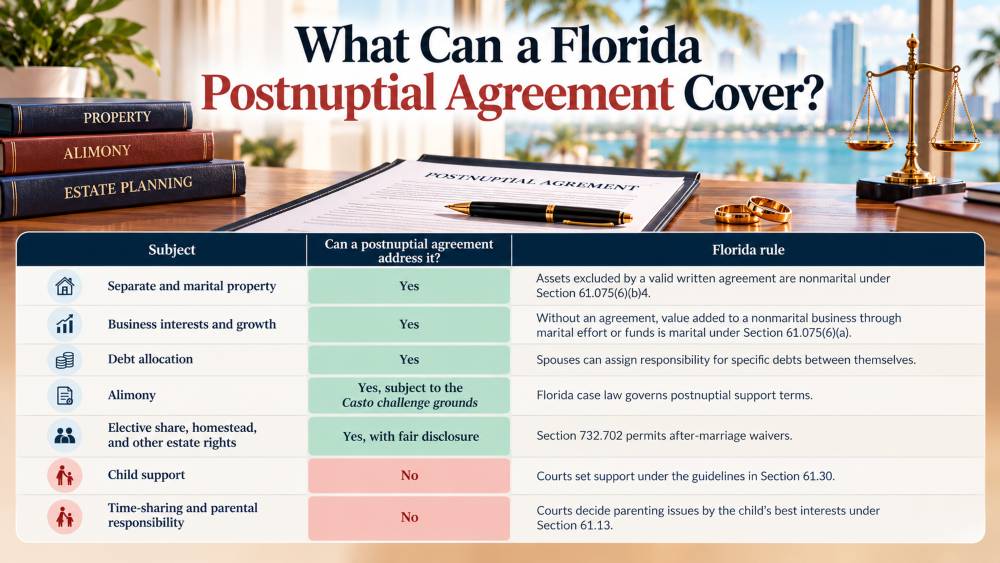
A Florida postnuptial agreement can cover property classification, debt allocation between the spouses, alimony terms, and estate rights, but it cannot override a court’s authority over child support or time-sharing. Florida law treats each subject as follows.
| Subject | Can a postnuptial agreement address it? | Florida rule |
| Separate and marital property | Yes | Assets excluded by a valid written agreement are nonmarital under Section 61.075(6)(b)4 |
| Business interests and growth | Yes | Without an agreement, value added to a nonmarital business through marital effort or marital funds is marital under Section 61.075(6)(a) |
| Debt allocation | Yes | Spouses can assign responsibility for specific debts between themselves |
| Alimony | Yes, subject to the Casto challenge grounds | Florida case law governs postnuptial support terms |
| Elective share, homestead, and other estate rights | Yes, with fair disclosure | Section 732.702 permits after-marriage waivers |
| Child support | No | Courts set support under the guidelines in Section 61.30 |
| Time-sharing and parental responsibility | No | Courts decide parenting issues by the child’s best interests under Section 61.13 |
Spouses can review wills, trusts, retirement and life insurance beneficiary designations, and homestead plans alongside the agreement, and later inheritance disputes can go to estate and probate mediation.
Casto v. Casto sets out two grounds on which a Florida court can set aside or modify a postnuptial agreement. Statutory formalities add separate requirements for any estate-rights waiver in the same document.
The first ground covers misconduct: fraud, deceit, duress, coercion, misrepresentation, or overreaching in reaching the agreement. The second ground requires the challenging spouse to first establish that the agreement is unfair or unreasonable given the spouses’ circumstances; only then does a presumption arise that the other spouse concealed assets or that the challenger lacked knowledge.
The defending spouse can overcome that presumption by showing complete and candid disclosure of property and income, or that the challenging spouse already had a general understanding of both. A bad bargain alone does not void an agreement.
Full disclosure of property and income is one of the two ways to overcome the Casto presumption in a contested Miami-Dade family law matter.
For estate rights, disclosure becomes mandatory: Section 732.702, Florida Statutes, requires fair disclosure before an after-marriage waiver, including a waiver of the elective share, which equals 30% of the elective estate under Section 732.2065.
Section 732.702 requires an estate-rights waiver to be in writing and signed by the waiving spouse before two subscribing witnesses if the waiving spouse is a Florida resident.
A waiver signed by a nonresident is valid in Florida if it was valid where signed. Meeting the witness requirement does not answer a Casto challenge based on misconduct or unfair terms.
Clear terms today prevent costly disputes later. Regina F. Zelonker, P.A. reviews existing drafts or outlines new agreements and the disclosure each requires.
A postnuptial agreement differs from a prenuptial agreement in timing, governing law, consideration, and disclosure rules for estate waivers. The main differences under Florida law are below.
| Feature | Prenuptial agreement | Postnuptial agreement |
| Timing | Signed before the wedding, effective at marriage | Signed during the marriage |
| Governing law | Section 61.079, Florida Statutes | Casto v. Casto and contract principles |
| Consideration for estate waivers | None beyond signing, under Section 732.702 | None beyond signing, under Section 732.702 |
| Disclosure for estate waivers | Not required under Section 732.702 | Fair disclosure required under Section 732.702 |
| Relationship between the parties | Prospective spouses | Spouses with existing duties of trust |
Couples who already have a prenuptial agreement can amend or revoke it after marriage only through a written agreement signed by both spouses, and Section 61.079 makes that amendment enforceable without consideration.
Spouses can negotiate a postnuptial agreement directly, through their attorneys, or with a neutral mediator in family mediation, and each route starts with the same exchange of financial records.
Spouses can collect these records before meeting with a family law attorney or mediator:
Issues settled in a signed, upheld postnuptial agreement do not need to be renegotiated if the spouses later separate, including in a cooperative divorce handled by both attorneys.
Are postnuptial agreements legal in Florida?
Yes, Florida courts enforce postnuptial agreements unless a spouse proves fraud, duress, coercion, or similar misconduct, or proves the agreement unfair given the circumstances and the other spouse cannot show full disclosure or the challenger’s general financial knowledge, under the test from Casto v. Casto.
Can a postnuptial agreement protect a business in Florida?
Yes, spouses can classify an existing business as separate property and decide how to treat later growth. Without that term, Section 61.075, Florida Statutes, generally treats value added through marital effort or marital funds as a marital asset subject to division.
Can a postnuptial agreement waive alimony in Florida?
Yes, spouses can set, limit, or waive alimony in a postnuptial agreement. A court can set the term aside for fraud or coercion, or when the waiver is unfair, and the other spouse cannot show full disclosure or the challenger’s general financial knowledge.
Can a postnuptial agreement decide child support or custody?
No, a postnuptial agreement cannot waive a child’s right to support or bind a Florida court on time-sharing. Florida courts calculate child support under Section 61.30 and approve parenting plans under Section 61.13 based on the child’s best interests.
Does a postnuptial agreement need witnesses in Florida?
A Florida resident must sign a waiver of estate rights before two subscribing witnesses under Section 732.702. A nonresident’s waiver is valid in Florida if it was valid where signed, and witnessing does not defeat a Casto challenge.
Can a postnuptial agreement waive the elective share in Florida?
Yes, a spouse can waive the Florida elective share, which equals 30% of the elective estate, in a postnuptial agreement. Section 732.702 requires fair disclosure of the other spouse’s estate first, and a Florida resident must sign the waiver before two witnesses.
Why would a couple sign a postnuptial agreement after years of marriage?
Couples sign postnuptial agreements after years of marriage when finances change, such as a new business, an inheritance, or one spouse leaving work for family duties. Reconciliation after separation and blended-family estate planning also lead long-married couples to define rights in writing.
Can a prenuptial agreement be changed after marriage in Florida?
Yes, Section 61.079, Florida Statutes, allows spouses to amend or revoke a premarital agreement after marriage through a written agreement signed by both spouses. The amendment is enforceable without consideration, while a spoken promise to change the agreement carries no legal effect.
A postnuptial agreement lets Florida spouses set property, debt, support, and estate terms after marriage, under Casto v. Casto rather than Section 61.079. Courts can set an agreement aside for misconduct, or for terms that are unfair given the circumstances when the other spouse cannot show full disclosure or the challenger’s general financial knowledge. A bad bargain alone is not enough. Estate waivers require fair disclosure and, for Florida residents, two witnesses, while child support and time-sharing remain with the court. It must be noted that every case is different. Generalizations, such as in this article, are just that: generalizations, and are subject to variations depending on each specific case.
Every marriage changes over time. Regina F. Zelonker, P.A. helps Miami-Dade spouses plan their next step with an agreement built on full disclosure.