
Enforcing a prenuptial agreement in a Florida divorce means asking the court to divide property and decide support under the terms the spouses signed before marriage, while challenging one means asking the court not to apply some or all of those terms.
For agreements signed on or after October 1, 2007, Section 61.079, Florida Statutes, places the burden on the spouse who opposes the agreement.
Regina F. Zelonker, P.A., a family law and mediation firm in Palmetto Bay and Coral Gables, Florida, drafts and reviews prenuptial agreements for Miami-Dade couples.
A contested agreement can change the outcome of an entire divorce. Regina F. Zelonker, P.A. reviews prenuptial agreements in a confidential consultation before positions harden.
The signing date decides which rules apply. Chapter 2007-171, Laws of Florida, created the Uniform Premarital Agreement Act, Section 61.079, effective October 1, 2007, for agreements signed on or after that date.
Agreements signed earlier remain subject to the case-law standard that preceded the act, based on the Florida Supreme Court’s decision in Casto v. Casto, 508 So. 2d 330 (Fla. 1987).
A 2007 Florida Bar Journal comparison explains how the two standards differ.
| Question | Agreement signed on or after Oct. 1, 2007 | Agreement signed before Oct. 1, 2007 |
| Governing standard | Section 61.079, Florida Statutes | Florida case law, led by Casto v. Casto |
| Grounds for a challenge | Involuntary signing; fraud, duress, coercion, or overreaching; or unconscionability plus all three disclosure failures | Misconduct such as fraud, deceit, duress, coercion, misrepresentation, or overreaching; or terms unreasonable given the spouses’ circumstances |
| Who carries the burden | The challenging spouse, throughout | The challenging spouse, unless unreasonable terms are shown, which creates a presumption that the other spouse hid assets or the challenger lacked knowledge |
| How the other spouse responds | Showing fair disclosure, a valid written waiver, or the challenger’s adequate knowledge | Overcoming the presumption with full disclosure or proof of the challenger’s general knowledge of the finances |
| Fairness measured | At signing, decided by the judge as a question of law | By the spouses’ circumstances under the case-law test |
Identifying the signing date is the first step in any Miami-Dade family law dispute over a prenuptial agreement.
The spouse relying on a prenuptial agreement asks the divorce court to apply it, and for covered agreements, the other spouse must prove a Section 61.079 defense to stop the agreement as a whole.
Validity is only the first question; the court may also need to decide what particular terms mean and whether they reach a given asset or issue.
The act requires the agreement to be in writing and signed by both spouses, and it takes effect when the marriage begins, with the marriage itself as the only consideration needed. Any later change or cancellation counts only if both spouses sign it in writing.
A valid agreement does not automatically settle every issue. Spouses can disagree about how a clause applies to a specific account or business, and issues the agreement never addressed follow Florida’s default divorce rules.
Spouses can resolve interpretation disputes like these before trial through family mediation.
Section 61.079 pauses any statute of limitations for claims under the agreement during the marriage, although either spouse can still raise equitable defenses such as laches or estoppel.
Section 61.079 recognizes three grounds for refusing to enforce a covered prenuptial agreement, and the challenging spouse must prove one of them. The first two grounds focus on how the agreement was signed; the third examines the terms and what each spouse knew.
A spouse can defeat the agreement by proving the signature was not given voluntarily. The focus is on the circumstances at signing, not on how the terms look years later.
A spouse can also defeat the agreement by proving the other spouse obtained it through fraud, duress, coercion, or overreaching.
The third ground requires two showings. The challenging spouse must prove the agreement was unconscionable when signed, and must also prove all three of these facts about the time before signing:
A document labeled a waiver does not end the inquiry by itself; its wording and the circumstances of signing decide whether it was an express and voluntary waiver. The judge decides unconscionability as a question of law.
A hypothetical shows the difference between an unequal agreement and an unenforceable one.
One spouse receives far less property under the agreement, but before signing received a full asset schedule and had weeks to review it; the result is lopsided, yet no disclosure failure exists.
If the same spouse had received no schedule, signed no waiver, and had no way to learn the other spouse’s finances, and the terms were unconscionable, the third ground would be available.
Every enforcement fight turns on documents and dates. Regina F. Zelonker, P.A. reviews the signed agreement and disclosure records before any hearing.
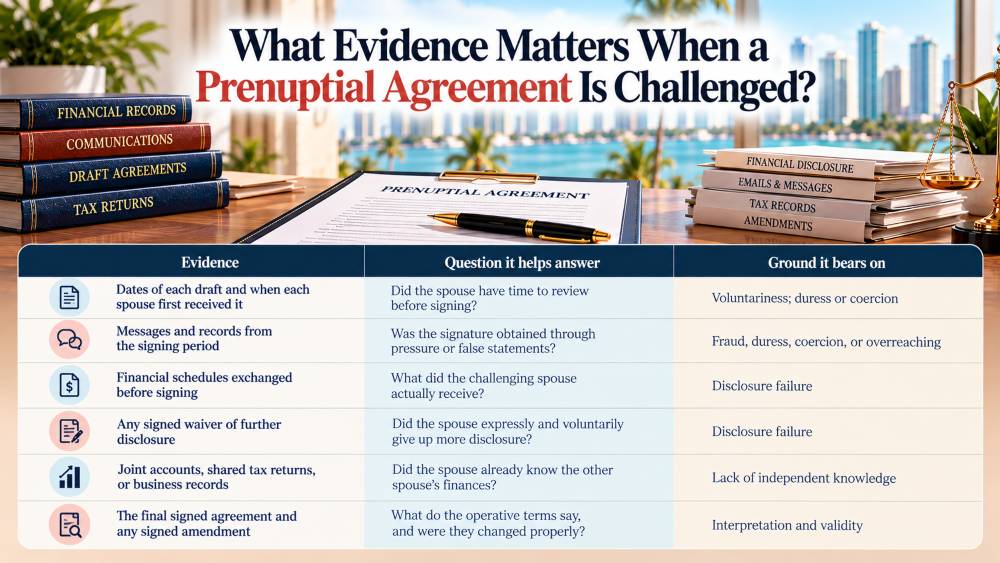
The useful evidence depends on which ground is in play, so each record below matches the question it helps answer.
| Evidence | Question it helps answer | Ground it bears on |
| Dates of each draft and when each spouse first received it | Did the spouse have time to review before signing? | Voluntariness; duress or coercion |
| Messages and records from the signing period | Was the signature obtained through pressure or false statements? | Fraud, duress, coercion, or overreaching |
| Financial schedules exchanged before signing | What did the challenging spouse actually receive? | Disclosure failure |
| Any signed waiver of further disclosure | Did the spouse expressly and voluntarily give up more disclosure? | Disclosure failure |
| Joint accounts, shared tax returns, or business records | Did the spouse already know the other spouse’s finances? | Lack of independent knowledge |
| The final signed agreement and any signed amendment | What do the operative terms say, and were they changed properly? | Interpretation and validity |
Official Miami-Dade clerk and self-help links appear on the firm’s court resources page for spouses preparing records.
Even an enforceable prenuptial agreement cannot control every issue in a Florida divorce. Section 61.079 and related statutes keep several subjects under the court’s authority.
| Subject | Court’s authority | Source |
| Child support | A prenuptial agreement cannot reduce a child’s right to support | Section 61.079(4)(b) |
| Spousal support waiver | A court can order support despite the agreement if the waiver would leave a spouse qualifying for public assistance when the marriage ends | Section 61.079(7)(b) |
| Time-sharing and parenting | Courts decide parenting issues by the child’s best interests | Section 61.13 |
| Void marriage | The agreement applies only to the degree needed to prevent an unfair outcome | Section 61.079(8) |
| Estate rights waivers | Rules for waivers of inheritance rights stay governed by the probate code | Section 732.702 |
Inheritance disputes that arise after a spouse’s death fall outside the divorce case and follow the probate rules instead.
Yes, spouses can settle a prenuptial agreement dispute by negotiating or mediating instead of asking a judge to rule, and Florida’s collaborative law statute lists marital agreements among the issues collaborative divorce can address.
Family mediation uses a neutral mediator who helps both spouses reach terms but does not represent either spouse or decide the dispute.
Collaborative divorce pairs each spouse with a collaborative attorney under a participation agreement, and those attorneys cannot continue into the related court case if the process ends without a settlement.
No matter the route, any settlement that changes the prenuptial terms requires a new written agreement signed by both spouses, and asking the court to approve an agreement with both spouses’ consent does not end a collaborative process.
Spouses who want both attorneys to stay involved if talks fail can compare cooperative divorce, which has no disqualification clause.
Four terms appear often in prenuptial agreement disputes, and each has a specific meaning:
Who has the burden of proof when a Florida prenuptial agreement is challenged?
For agreements signed on or after October 1, 2007, Section 61.079 places the burden on the spouse opposing enforcement. That spouse must prove involuntary signing, fraud, duress, coercion, or overreaching, or prove unconscionability combined with all three of the statute’s disclosure failures.
Can a prenuptial agreement be thrown out for being unfair in Florida?
No, unfairness alone is not enough under Section 61.079 for agreements signed on or after October 1, 2007. The challenger must prove the agreement was unconscionable when signed and that there was no fair disclosure, no effective written waiver, and no adequate knowledge of the other spouse’s finances.
Does a signed disclosure waiver protect a Florida prenuptial agreement?
A waiver helps only if it was an express, voluntary waiver of further disclosure signed in writing. If it qualifies, the challenging spouse cannot satisfy all three disclosure conditions, but the waiver’s wording and the circumstances of signing still determine whether it qualifies.
Can a prenuptial agreement waive alimony in Florida?
Yes, a prenuptial agreement can modify or eliminate spousal support. If the waiver would leave a spouse qualifying for public assistance when the marriage ends, Section 61.079(7)(b) lets the court order the other spouse to pay enough support to prevent that outcome.
Can a prenuptial agreement decide child support in Florida?
No, Section 61.079(4)(b) bars a prenuptial agreement from reducing a child’s right to support. Florida courts also decide time-sharing and parenting plans under Section 61.13 based on the child’s best interests, regardless of the terms the parents signed before they married.
Is there a deadline to challenge a prenuptial agreement in Florida?
Section 61.079 pauses any statute of limitations for claims under the agreement while the marriage lasts. Either spouse can still raise equitable defenses such as laches or estoppel, so delay after a problem becomes known can still affect a challenge.
Does each spouse need a separate lawyer for a Florida prenuptial agreement?
No, Section 61.079 does not require separate lawyers for a valid agreement. Its grounds for refusing enforcement center on voluntary signing, misconduct, and disclosure, so the circumstances of review and signing matter more to a challenge than any single formality.
How are pre-2007 Florida prenuptial agreements challenged?
Agreements signed before October 1, 2007, follow Casto v. Casto. A spouse can prove misconduct or show the terms are unreasonable given the circumstances, shifting the burden to the other spouse to prove full disclosure or the challenger’s general financial knowledge.
The signing date decides the rules: Section 61.079 covers agreements signed on or after October 1, 2007, and Casto v. Casto governs older ones. Under Section 61.079, the challenging spouse carries the burden, and the right evidence depends on whether the challenge targets the signing process or the terms and disclosure. The court still controls child support, parenting decisions, and support waivers that would leave a spouse on public assistance. It must be noted that every case is different. Generalizations, such as in this article, are just that: generalizations, and are subject to variations depending on each specific case.
Clarity about the agreement makes every next step easier. Regina F. Zelonker, P.A. helps Miami-Dade spouses review their prenuptial agreement before divorce proceedings begin.